SAS Hackathon 2026 · Manufacturing
Lantern
SAS Viya works out what needs doing in a factory each week. Lantern is where the team does it: every action goes to the person who owns it, they talk it through, do the work and record what they did, and SAS checks whether it worked.
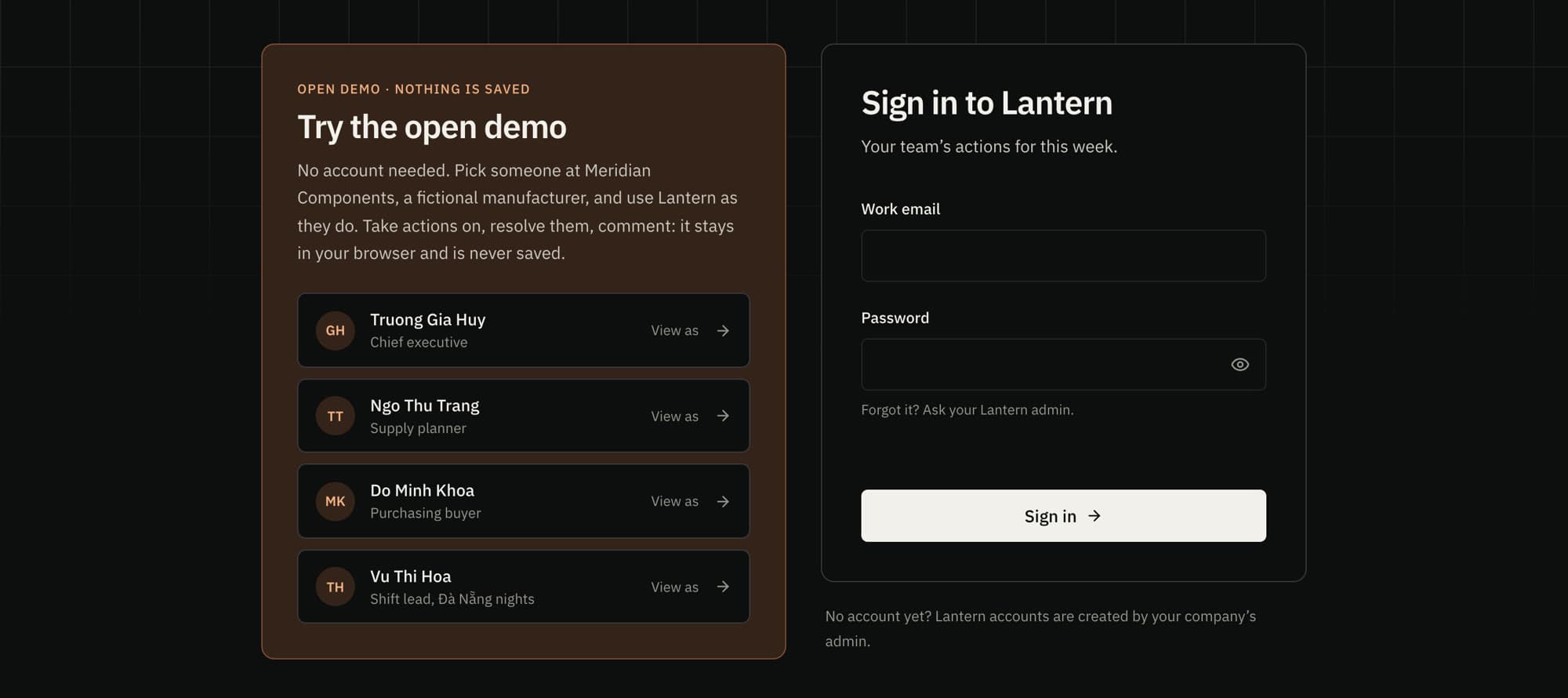
The demo opens in a new tab as someone at Meridian Components, a made-up manufacturer. Nothing you do there is saved.
- Department files in
- 19
- Cleaning rules
- 40
- Rows they fixed
- 28,098
- Actions from one weekly run
- 306
- Languages
- 6
From the build's own output, on the made-up company's data.
Why I built it
For my father
My father owns a factory in the south of Vietnam. It is his life's work. When I came home after years in the U.S., I went to see it again, and I wanted a way to talk with him about it. I had been away a long time, and the business was something we could share.
He is a traditionalist. He believes in hard work, in being thorough, and in what people put in. So do I. But technology keeps moving: in machines, in software, in how people work and how they read their data. Much of his company still runs by hand, and on the memory of people who are close to retiring.
So I thought about my own work. At the trucking company where I started, we built one place that showed everyone the bottleneck costing the business the most, so the right people could act on it early. It taught me that a number only matters once someone owns what happens next. That became Lantern.
Funny enough, my first SAS tool was JMP, back when I was learning statistics in college. I never thought it would lead here.
Why Lantern
The name comes from Hội An, an old town in central Vietnam, where the river carries lantern light past houses older than any of us. A lantern does not chase the dark away. It just shows you the next step, and lets you walk it yourself.
That is what I want Lantern to do. SAS lights the next step; the person who owns it takes it.
So this is a love letter to my country. I hope we keep our light: guiding others gently, keeping the beauty that is ours, and still holding our own against the world.
Tea
The problem
Workbooks everywhere
A mid-size manufacturer runs on department spreadsheets. Planning, purchasing, the plants and finance each keep their own numbers, the reports disagree, and a loss is usually found after the money has gone.
Analytics can say what is about to go wrong. Then a dashboard shows it to everyone, and nobody in particular does anything.
The idea
One owner each
Let SAS clean the files, forecast, score the risk and decide. Then hand every decision to one person, in a workspace where people, SAS and an assistant work on it together.
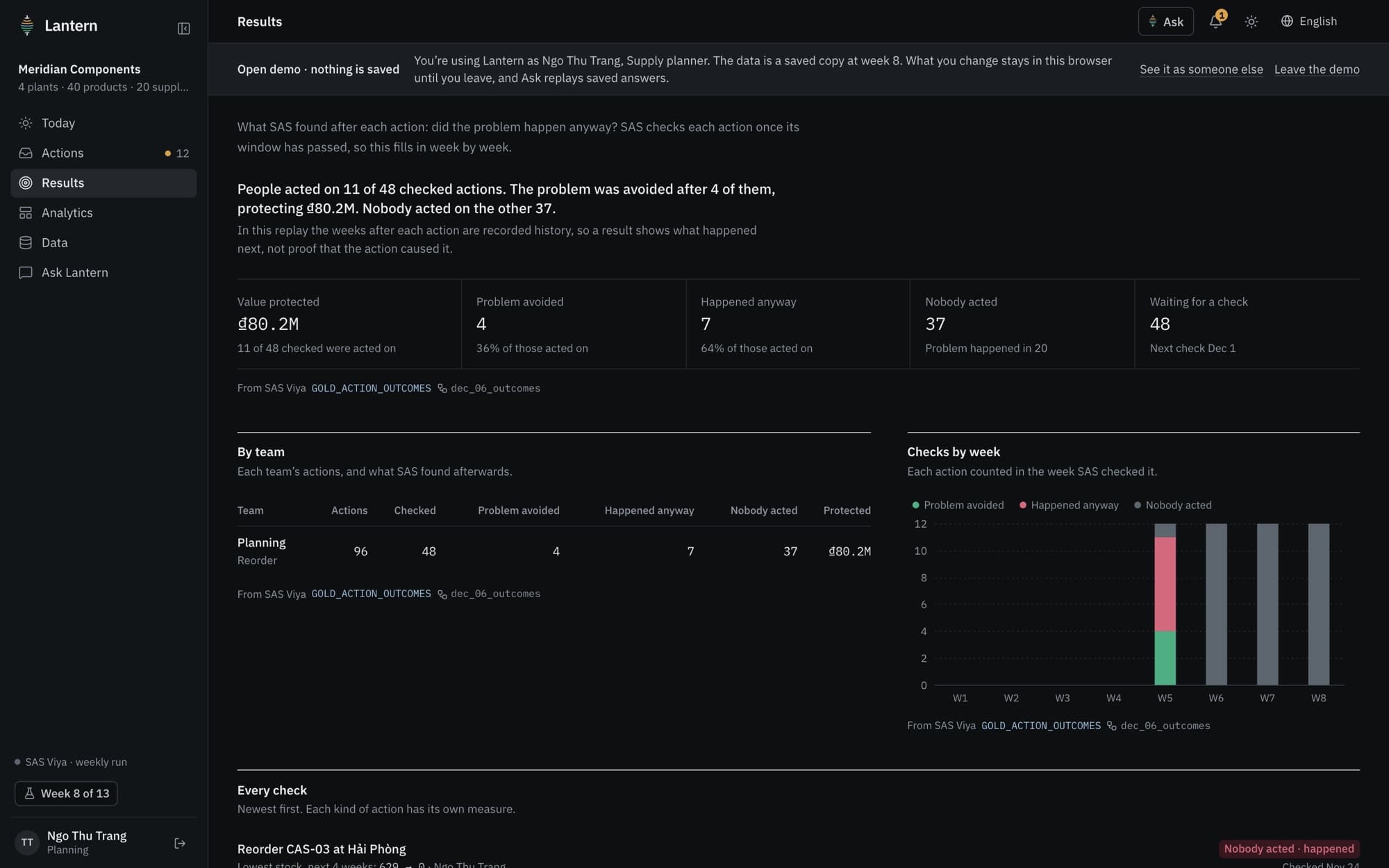
And close the loop: what people did goes back to SAS, which measures what it was worth.
How it works
The action desk
A toy version of the weekly loop. Press the buttons and watch where each action goes.
- Files cleaned
- 0
- Actions raised
- 0
- Resolved
- 0
- Nobody acted
- 0
- Checked by SAS
- 0
01
Files
Nineteen department spreadsheets, each with its own habits: money typed as text, mixed date formats, local shift codes.
02
Clean
SAS flows apply 40 logged rules, so every fixed cell can be traced back to the file it came from.
03
Decide
Models forecast demand and score stockout risk. A published decision turns each risk into an action with a reason and money at risk.
04
Assign
Each action has one owner. A shift lead sees their own plant and shift; the chief executive sees everything.
05
Act
The owner takes it on, talks it through with the team, does the work, then records what they did.
06
Check
Every decision goes back to SAS. Once an action's window passes, SAS checks whether the problem was avoided.
Along the way
Notes from the build
A few weeks, mostly at night. What it was like, in the order it happened.
In Viya
A calm place to work
The first thing I noticed about SAS Viya was how calm it is. Clean screens, one job at a time, nothing shouting for attention. I expected enterprise software to feel heavy. Viya felt smooth, almost elegant, and I liked being in it.
In Viya
Nineteen files that disagree
Meridian arrived the way real companies do: nineteen department files that do not agree with each other. I cleaned them in SAS Studio flows, which read like a drawing of the work. Forty logged rules fixed 28,098 rows, and every fix was written down.
In Viya
The code was nice too
I wrote more SAS code than I expected, and I enjoyed it. The program, its log and its results are one click apart, so you always know what just happened and why.
In Viya
A small lesson
Data Explorer guessed column types from the first twenty rows and quietly blanked 204 values. Nothing failed; the numbers were just wrong. Now I count rows and empty values after every load.
In Viya
Where it clicked
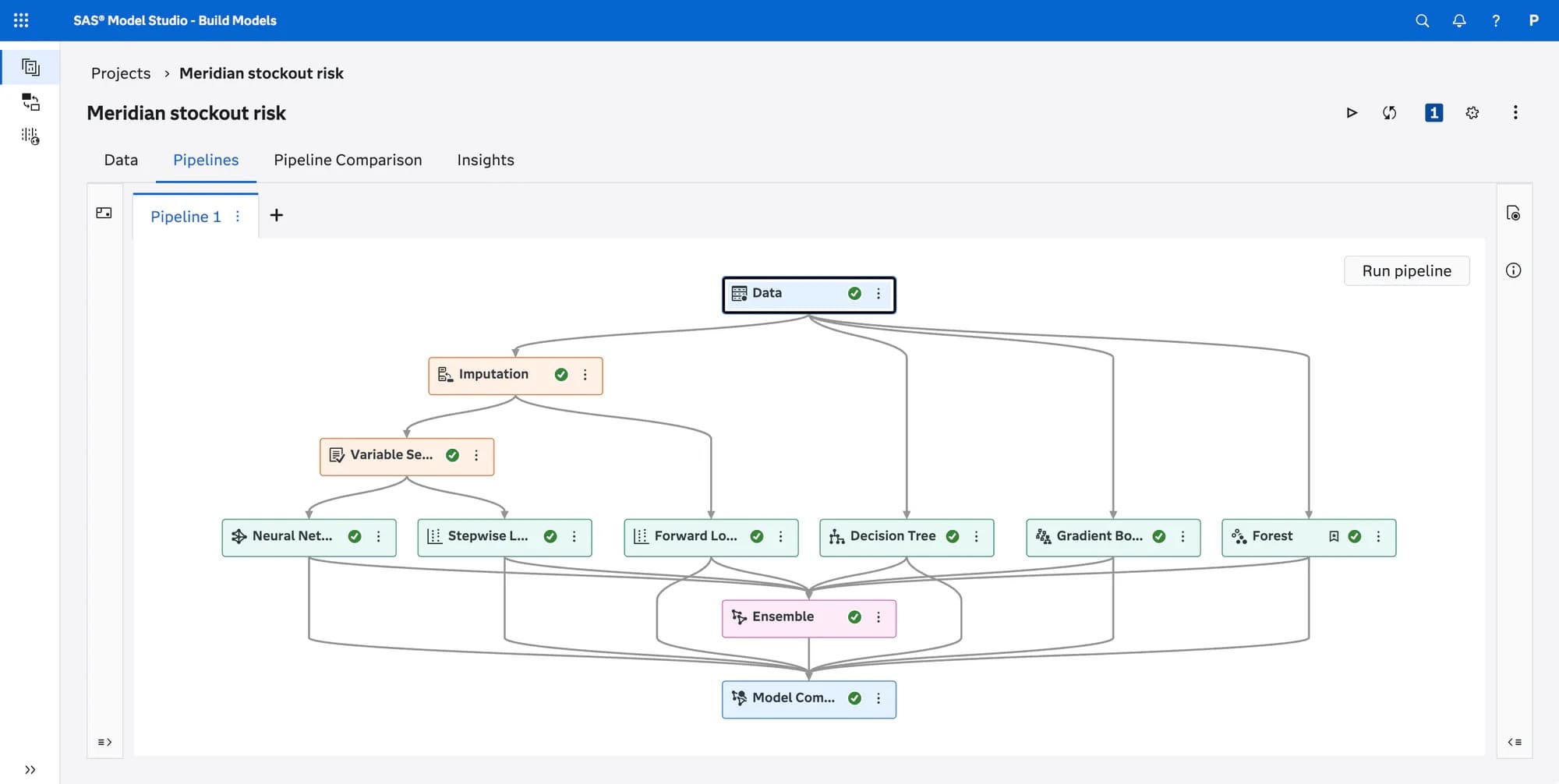
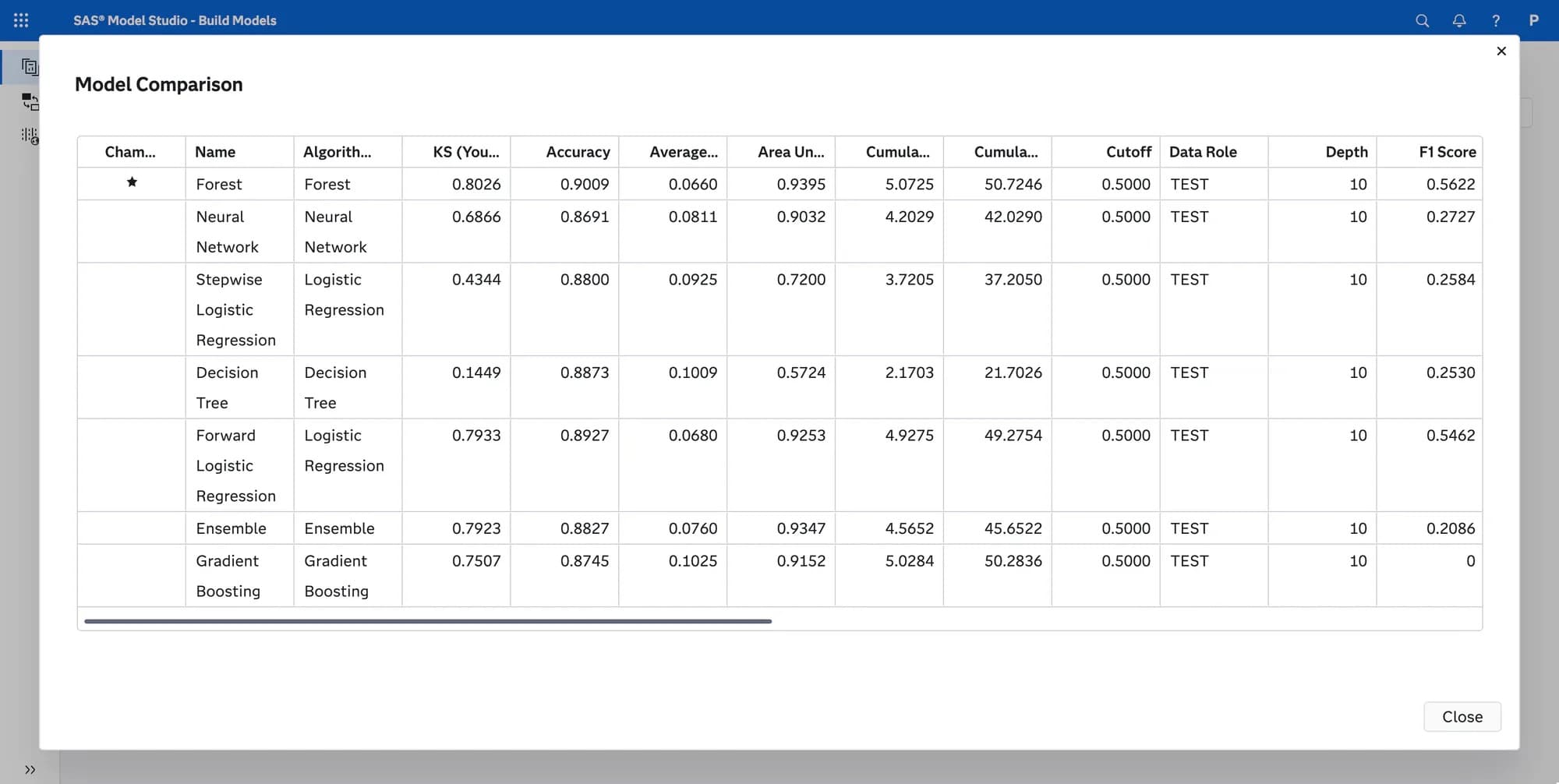
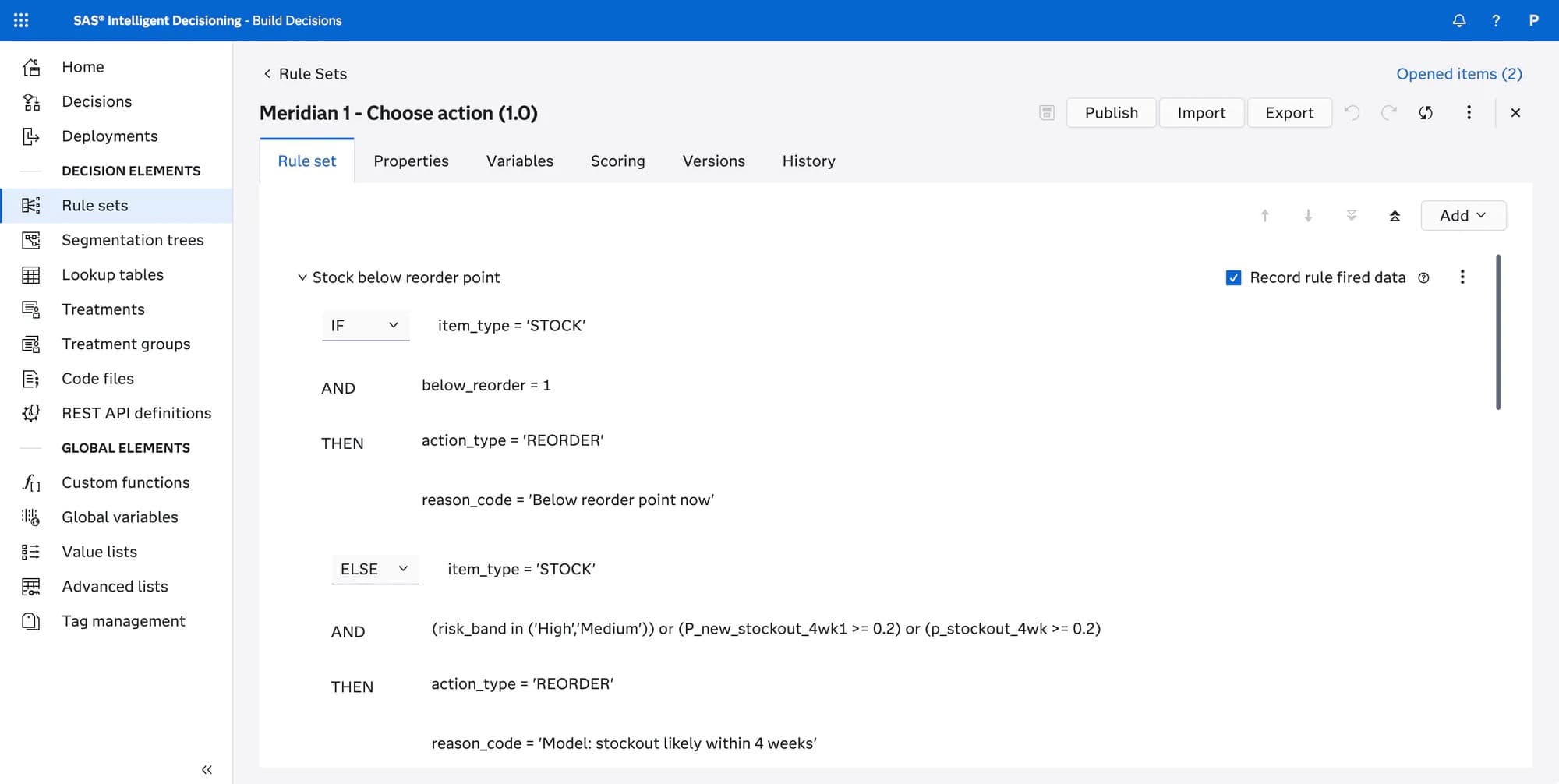
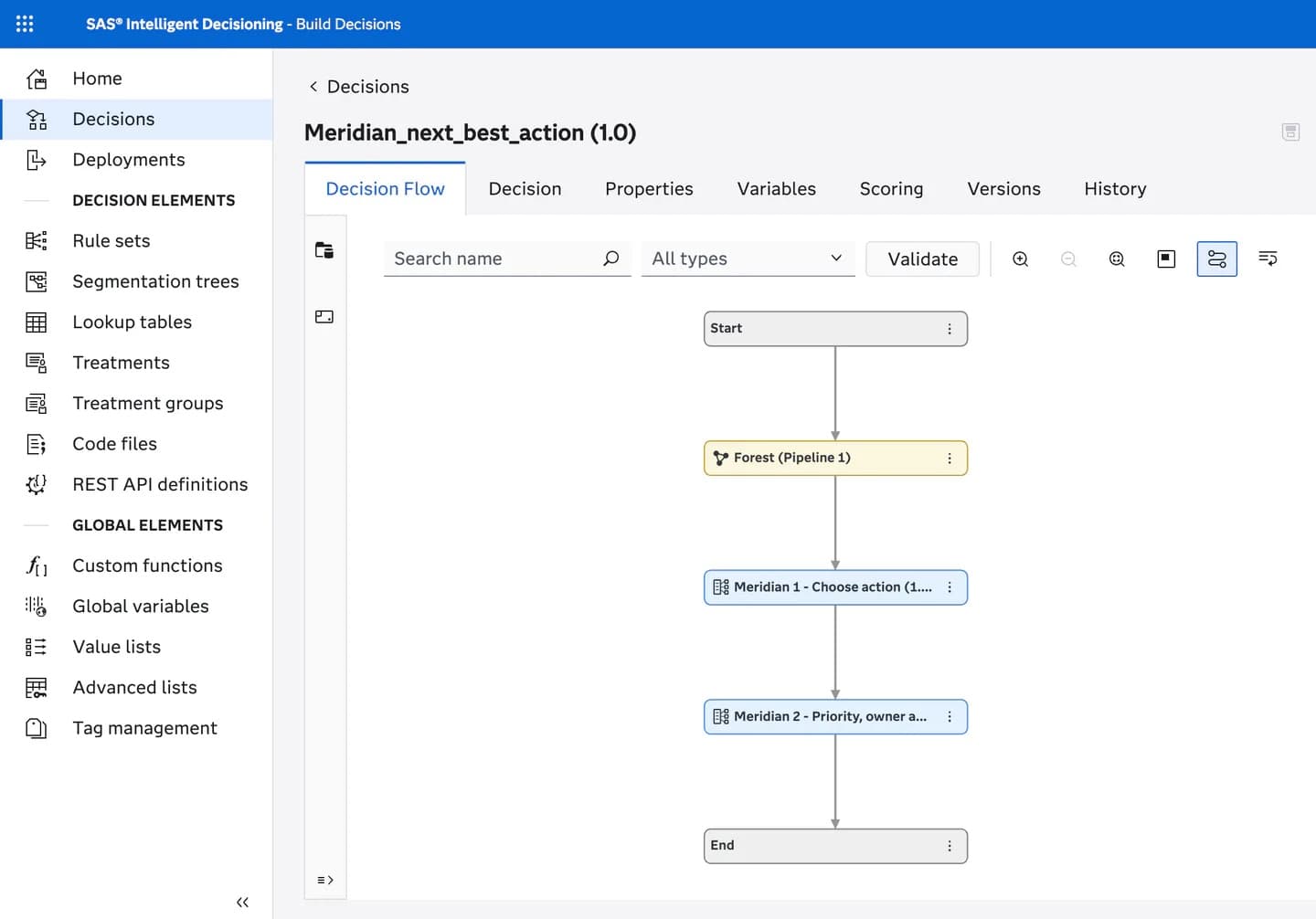
Model Studio lined the pipelines up side by side, and a forest won with a held-out AUC of 0.939. Then Intelligent Decisioning turned models and rules into actions with an owner, a priority and a deadline. That was the moment it stopped being a chart and became somebody's job.
20 Oct
The workspace
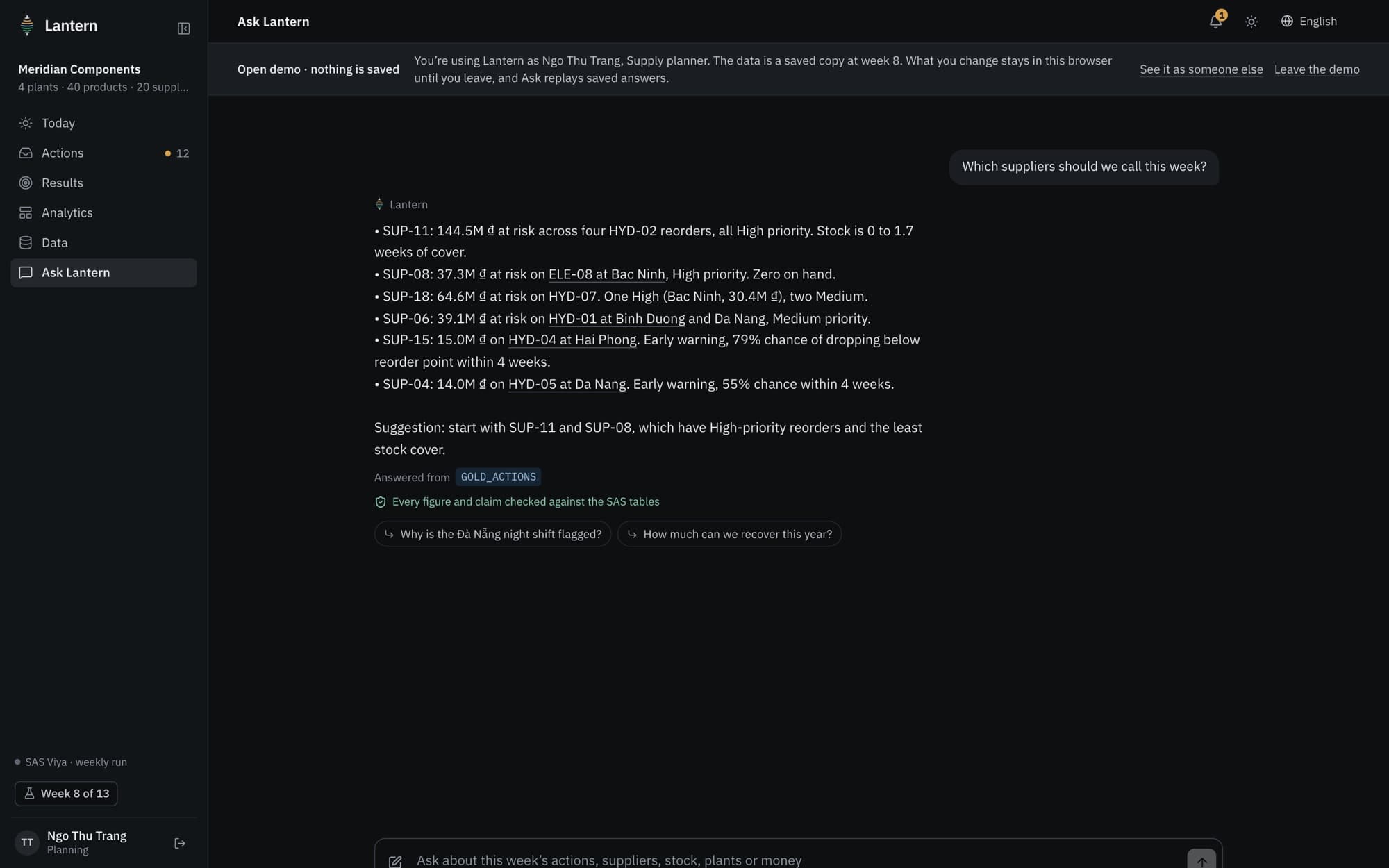
With SAS solid underneath, Lantern came together: actions, reports, data and Ask, in six languages. I made Ask check every number against the SAS table it came from. If it cannot, it says so.
23 Oct
Closer to home
Until now Lantern ran on a small computer on my desk, through a tunnel. I moved it to servers in Singapore, and from Vietnam it suddenly felt instant.
29 Oct
Packing up the lanterns
Our Viya environment would be deleted after the 31st, so I exported everything: 75 tables, 180,189 rows, the programs, the reports and the champion model.
30 Oct
Leaving the door open
An open demo, so anyone can look around as someone at Meridian. What they change stays in their own browser.
31 Oct
The lights stay on
Viya closed for us today. Lantern still runs on its last results, and I am a little proud of that.
Screens
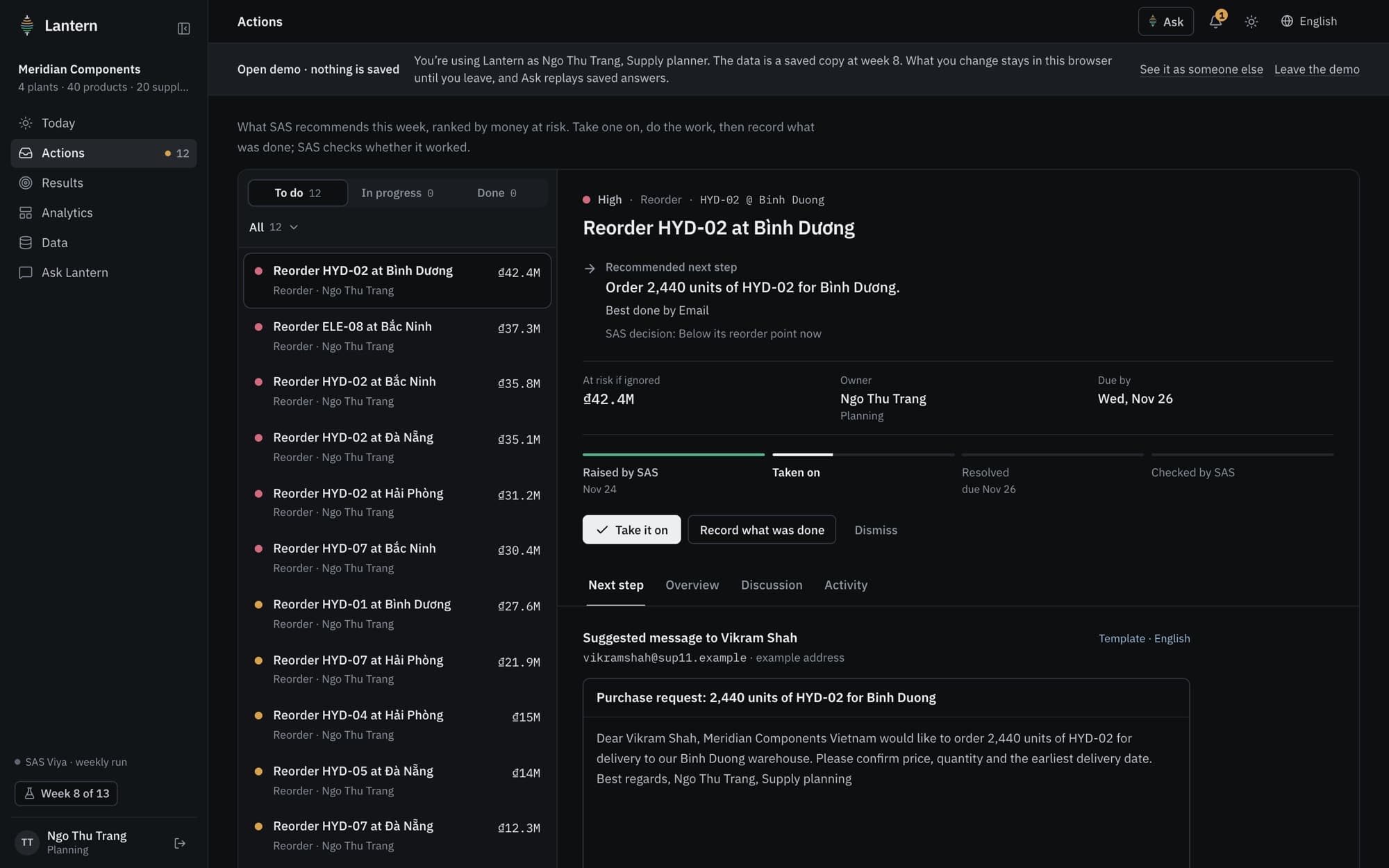
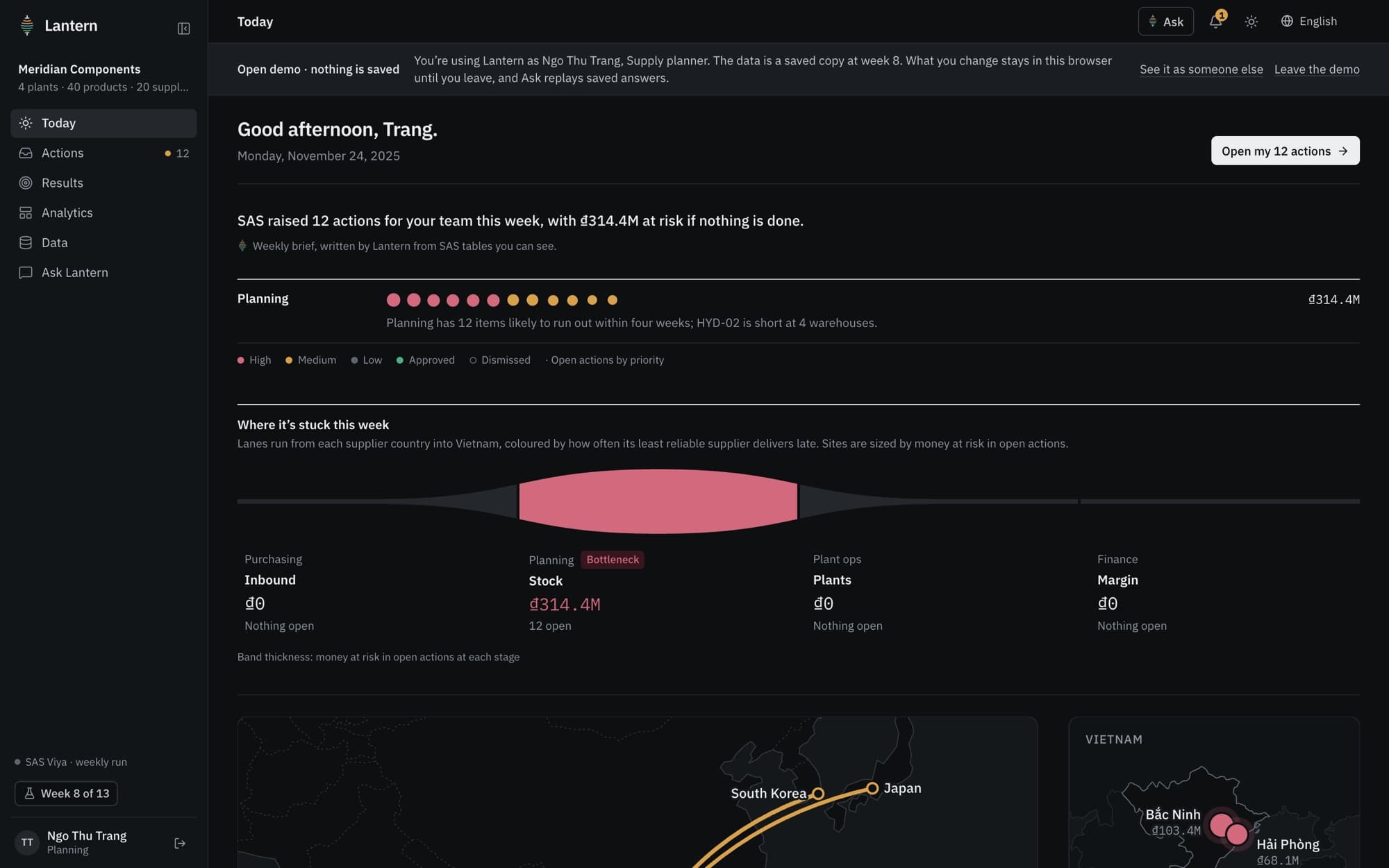
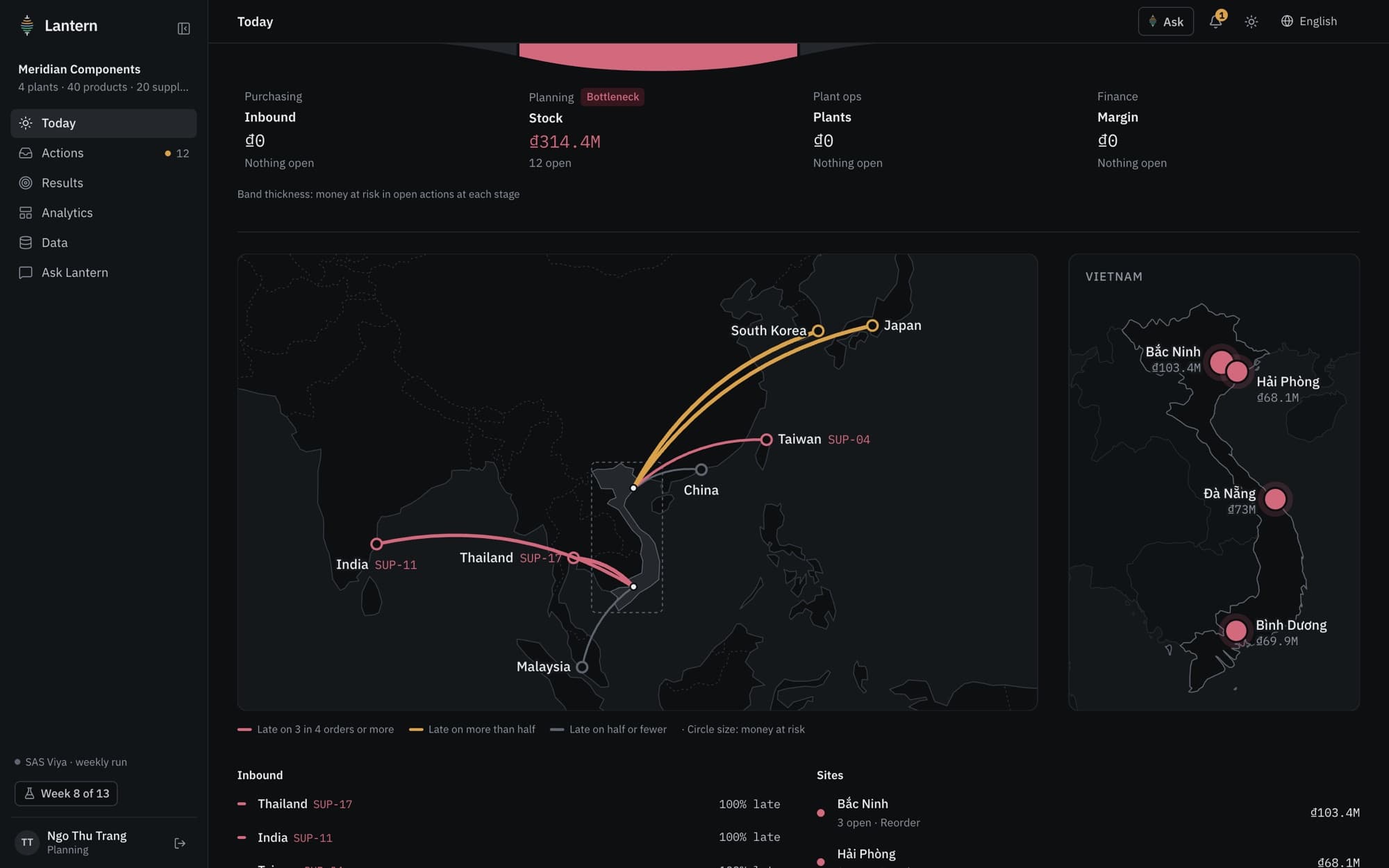
Inside Lantern
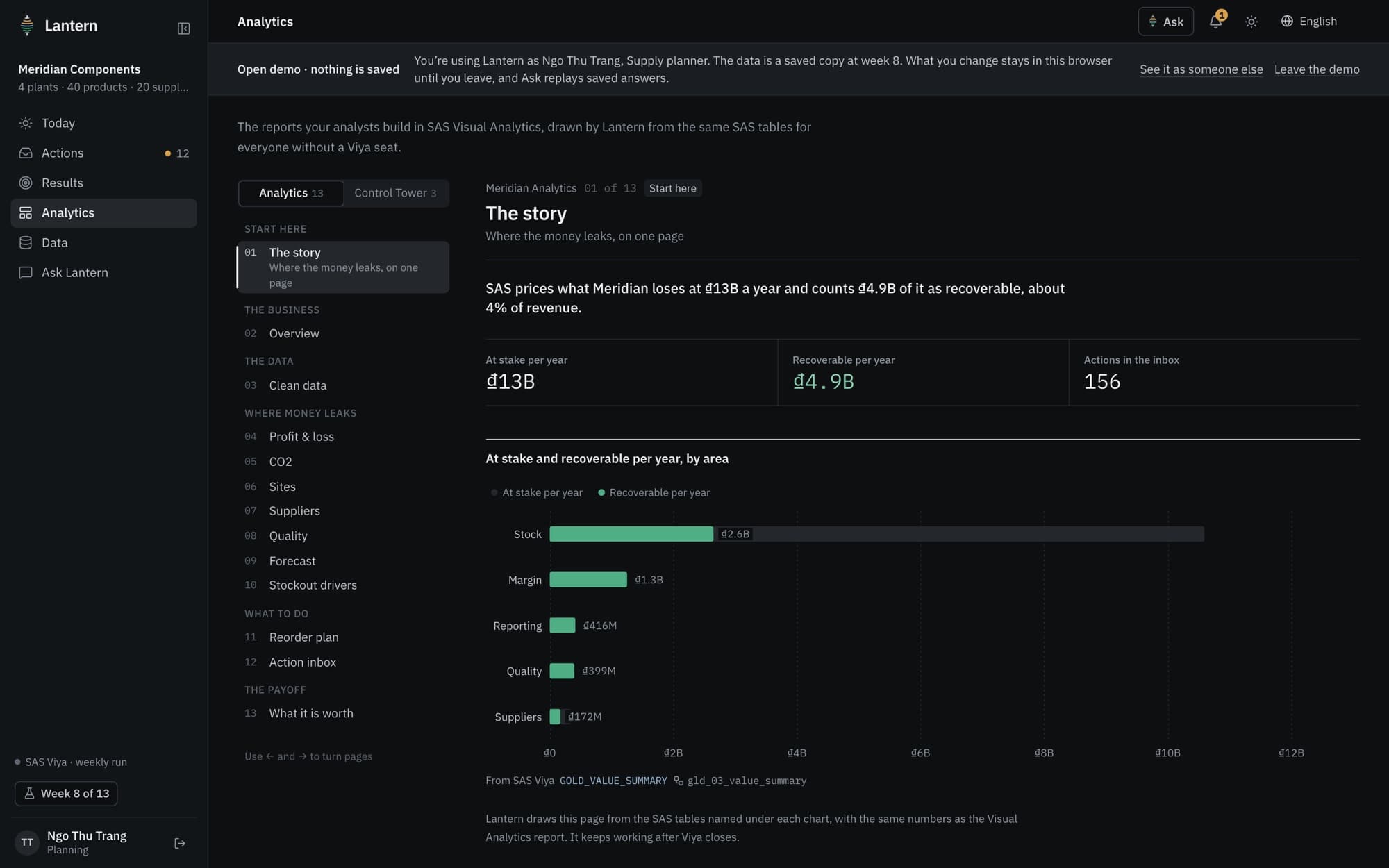
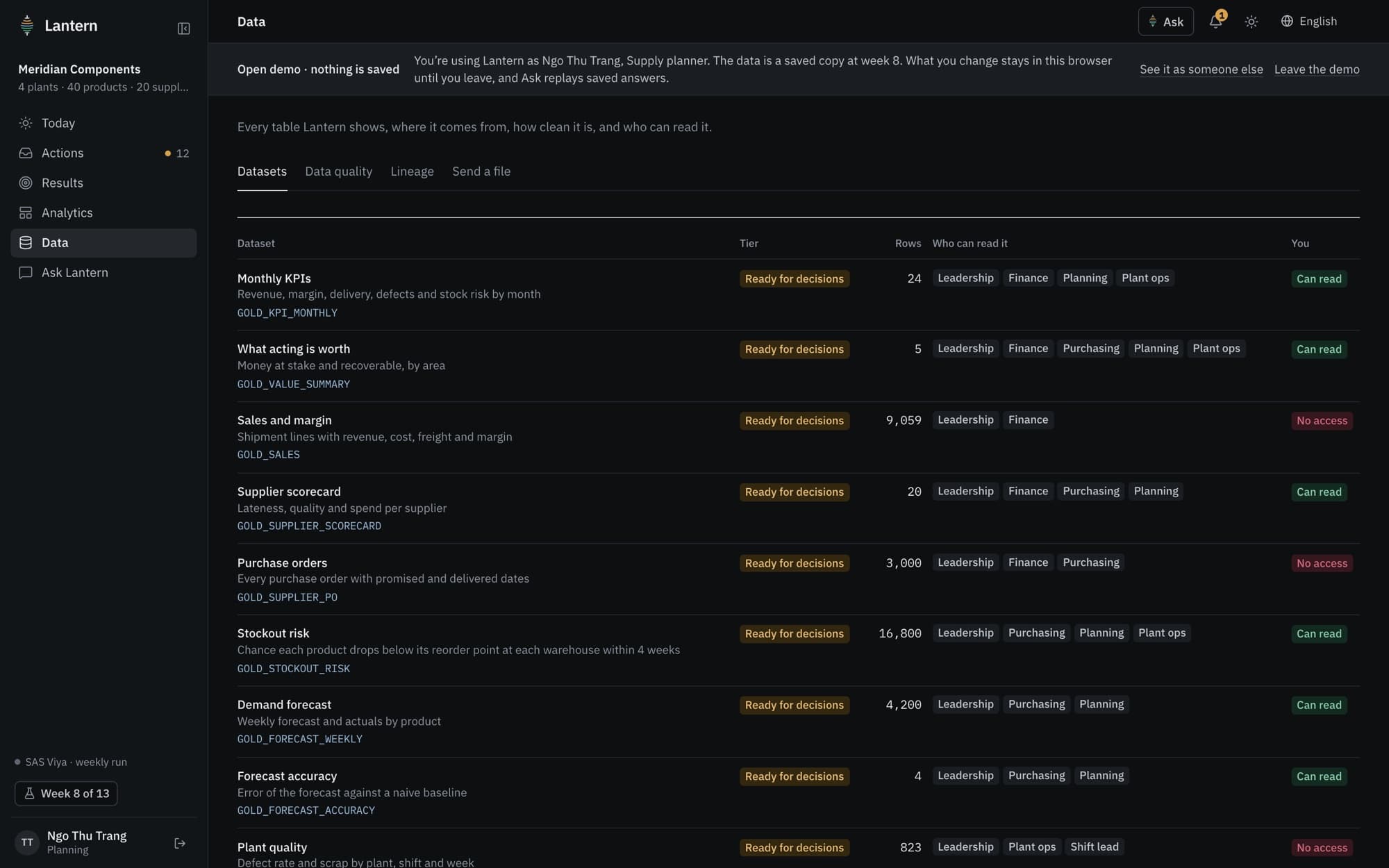
What the planner sees in the open demo, in week 8 of a 13-week replay.
Screens
Inside SAS Viya
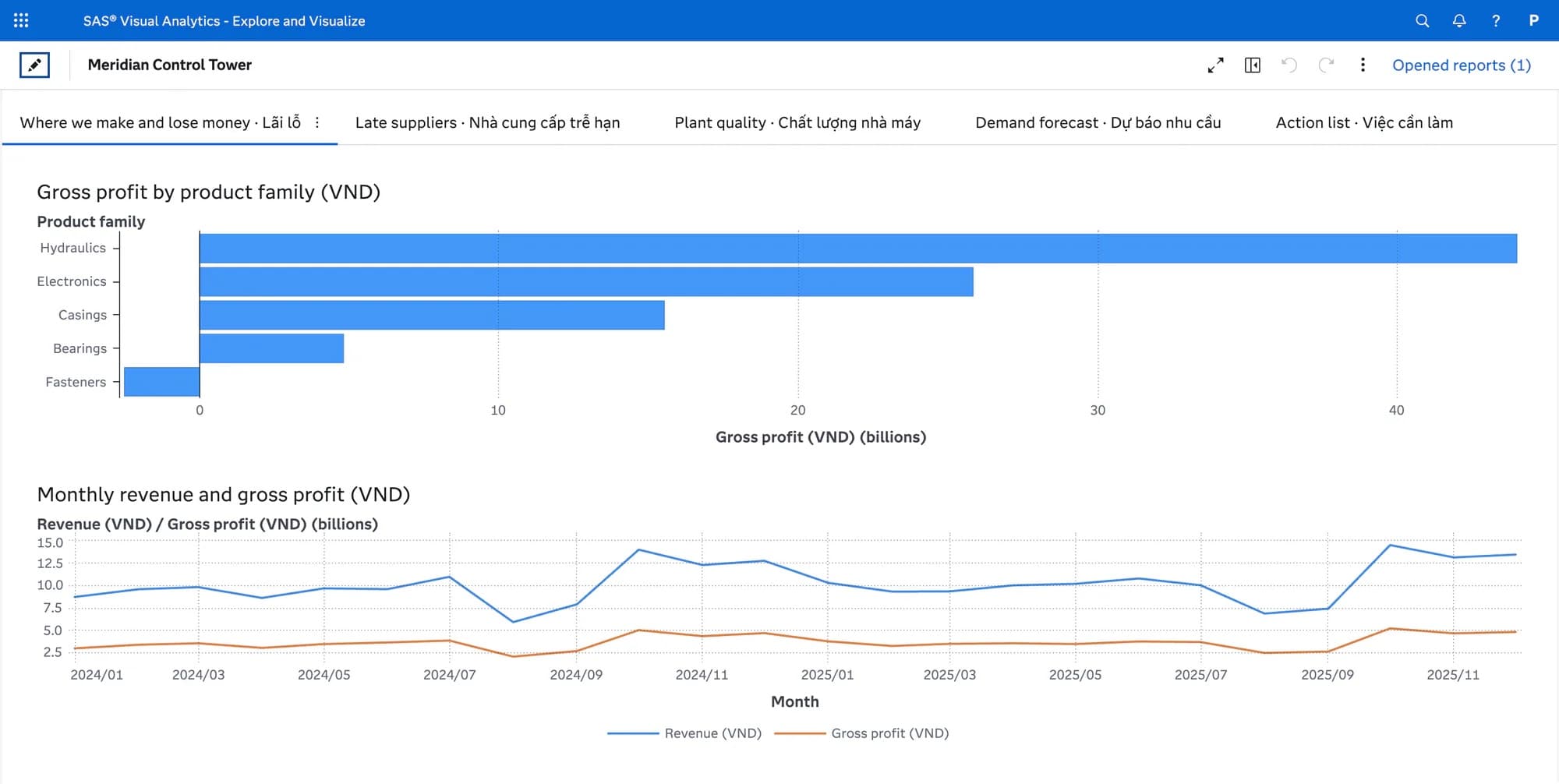
The other half. These were taken in the hackathon's Viya environment before it closed on 31 October 2026.
Design
How it looks
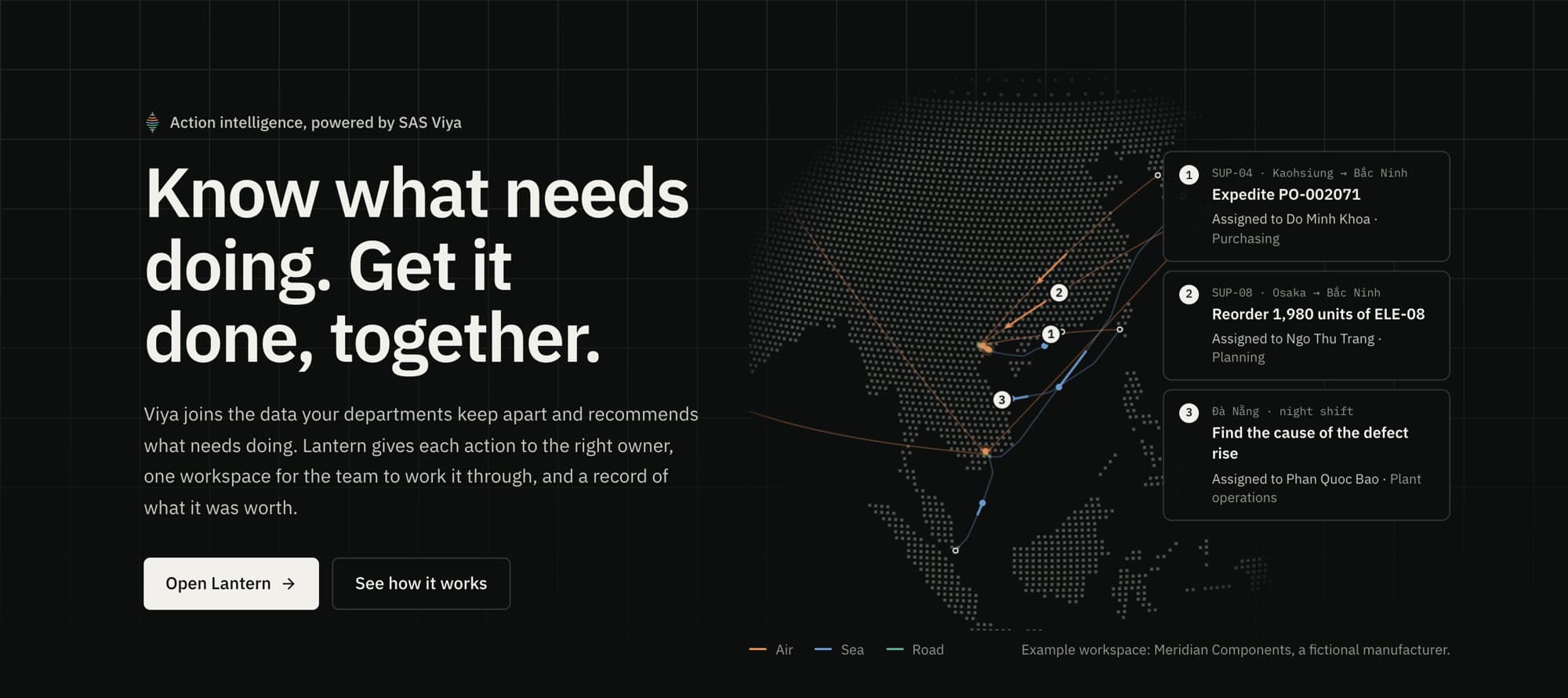
- A calm product, not a wall of charts. Each page leads with one sentence that says what matters this week.
- Light and dark, soft colours, no shadows. Money in đồng and place names in Vietnamese, because that is where the plants are.
- Under every chart, the SAS table it came from. A number nobody can trace is a number nobody trusts.
- Six languages from one switch: English, Vietnamese, Korean, Japanese, and Simplified and Traditional Chinese.
Why it is built this way
- SAS decides, and nothing around it recalculates. Lantern shows SAS's numbers and never makes its own.
- Viya seats go to the few people who build the analytics. Everyone else acts in a plain web app.
- Who sees what is enforced by the database itself, row by row. Decisions are append-only, so the record cannot be edited later.
- Ask can only answer from tables the person may read, and every figure is checked against them before it appears.
- When the hackathon's Viya closed, the reports were redrawn from the same tables, so the product kept working.
- The open demo reads a saved copy and keeps a guest's changes in their browser. It cannot reach the database or a language model.
How it feels
This one was a sprint: a whole product, a SAS build behind it and a film for the jury, in a few weeks with my team.
My favourite part is the loop. SAS decides, people act, and SAS checks whether it worked. Most dashboards stop at the first step.
Tea
What it runs on
- SAS Viya
- Studio flows, Model Studio, Model Manager, Intelligent Decisioning, Optimization, Visual Analytics, a weekly job
- App
- Next.js on Vercel
- Data
- Postgres with PostgREST and row-level security
- n8n and Resend
- Ask
- A language model, answering only from SAS tables
Open demo
Try it yourself
Pick someone at Meridian and use Lantern as they do. Take an action on, resolve it, leave a comment, ask a question.